
 Cassettefrom $1,312

What does BTU mean on a mini split, and is a bigger one better?
Short answer: On a mini split, BTU is how much heat the system can move out of a room (or into it) in one hour, and 12,000 BTU equals one ton. A bigger number is not a better system. A unit that is too large for the room runs in short bursts, leaves the air damp and costs more up front, while a well matched inverter unit runs long, slow and steady.
BTU explained in plain terms is the first step before you pick a size. Once you know what the number on the box measures, the sizing math makes sense, and so do the warnings about oversizing.
What is a BTU?
A BTU, or British thermal unit, is the heat it takes to raise one pound of water by 1°F. That's roughly the heat from burning one kitchen match.
Air conditioners and heat pumps are rated in BTU per hour. When we say "12K," we mean the system can move 12,000 BTU of heat every hour at its rated output. In cooling mode it carries that heat from your room to the outdoor unit. In heat mode it runs the other way and brings heat in from outside air, even on a cold day.
How many tons is a 12,000 BTU mini split?
One ton. The term goes back to ice: one ton of cooling is the heat needed to melt a ton of ice over 24 hours, which works out to 12,000 BTU per hour. Contractors often talk in tons, while mini split listings use BTU.
| Capacity | Tons | Where you'll see it in our store |
|---|---|---|
| 9,000 BTU (9K) | 0.75 | Single zone: DIY Select, DIY EasyPro, DIY 5th Gen |
| 12,000 BTU (12K) | 1 | Single zone: all three lines |
| 18,000 BTU (18K) | 1.5 | Single zone: all three lines; 5th Gen multi-zone outdoor unit |
| 24,000 BTU (24K) | 2 | Single zone: all three lines |
| 27,000 BTU (27K) | 2.25 | 5th Gen multi-zone outdoor unit, 2 to 4 rooms |
| 36,000 BTU (36K) | 3 | 5th Gen single zone; 5th Gen multi-zone outdoor unit, 2 to 5 rooms |
| 48,000 BTU (48K) | 4 | 5th Gen multi-zone outdoor unit, 2 to 6 rooms |
| 55,000 BTU (55K) | about 4.6 | 5th Gen multi-zone outdoor unit, 2 to 6 rooms |
Does a higher BTU use more electricity?
BTU is output, not power use. What the unit draws from your panel depends on how efficient it is.
One watt of electricity turned into heat equals about 3.412 BTU per hour. A heat pump does far better than that, because it moves heat instead of making it. SEER2 tells you how much: it's the BTU of cooling you get per watt-hour, averaged over a season.
So a 12K at a SEER2 of 20 averages about 600 watts at full output (12,000 divided by 20). A 24K at the same SEER2 averages about 1,200 watts at full output. A correctly sized unit spends most of its time well below full output, so its real draw is lower than that.
Next: How do I estimate what a 12K mini split costs to run?
What does an inverter do with those BTU?
Old window units and basic central air run one speed. The compressor is either on at 100% or off.
Every system we sell, DIY Select, DIY EasyPro and DIY 5th Gen, uses an inverter compressor that changes speed. It ramps up on a hot afternoon or after you come home to a stuffy room, then slows down to hold the temperature you set.
The rated BTU is the nominal capacity. In daily use the compressor works across a range, and for much of the year it runs well below that number. Slow, steady running is where an inverter is most efficient and where it does its best job on humidity.
Why is a bigger mini split not better?
It short cycles
An inverter can slow down, but only so far. Each unit has a minimum speed. When a room needs less cooling than that minimum, the system reaches your setpoint, shuts off, warms up a bit, and starts again.
Those repeated starts waste energy compared with steady low-speed running, and they put more wear on the compressor over the years.
It leaves the room damp
A mini split dries the air by running it over a cold indoor coil, where moisture condenses and drains away. That takes time. In short runs, the coil doesn't stay cold long enough, and some of the water on it evaporates back into the room when the compressor stops.
That's why an oversized unit can show 72°F on the remote while the room feels sticky. Dry mode helps on muggy days, but it can't fully make up for a unit two sizes too big.
It's less comfortable and costs more
A large unit in a small room blows harder, so you feel drafts near the head and bigger swings in temperature. You also pay more up front, and 18K and larger units need a 230V circuit where the 9K and 12K run on 115V.
- Signs of oversizing: the room hits the setpoint within minutes and the compressor stops, the air feels clammy, and you get cold blasts near the indoor unit.
- Signs of undersizing: the fan runs on high all afternoon and never reaches the setpoint, or in winter the room can't hold 68°F on the coldest nights.
- A good match: long, quiet run times, steady temperature, and dry-feeling air in July.
Is the heating BTU the same as the cooling BTU?
The size name is the same, but the heating rating can differ from the cooling rating. Heating output also changes with the weather: as it gets colder outside, a heat pump has less heat to collect, so its output drops.
HSPF2 is the heating version of SEER2, and higher is better. All three lines keep heating down to −13°F outside; below that, keep a backup heat source or size up. The single zone specifications page lists heating and cooling figures for each size, so check it if winter heat is your main concern.
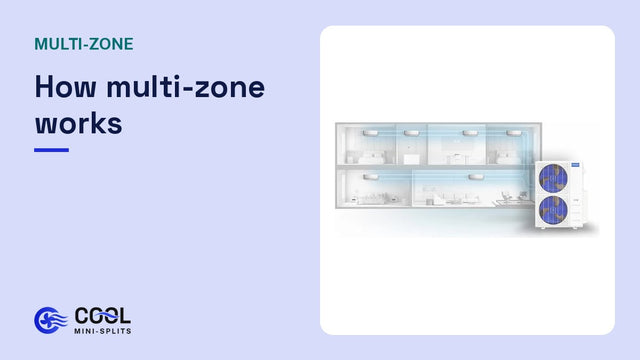
What if my multi-zone indoor units add up to more than the outdoor unit?
That's allowed, and it's normal. On the DIY 5th Gen multi-zone, the indoor units can total more than the outdoor unit's rating.
Take a 27K outdoor unit with three 12K rooms, which adds up to 36K of indoor units. When one or two rooms are running, each gets what it asks for. When all three run hard at once, the outdoor unit shares its 27K between them, about 9K each, and never goes over. Nothing breaks.
So you size the outdoor unit for the rooms that run at the same time on the hottest or coldest day, not for the total on paper. Browse the multi-zone systems to see how the outdoor sizes pair up.
Next: How does a multi-zone system share capacity between rooms?
What if I'm replacing a window unit with the same BTU?
The BTU scale is the same, so a 10,000 BTU window unit and a 9K or 12K mini split are in the same range. Don't copy the old number without checking, though.
People often tell us their window unit "never kept up" and ask for an 18K. A window unit that ran on and off at one speed, with air leaking around its frame, is a poor yardstick. Measure the room and run the numbers instead of jumping two sizes.
What should you do next?
Now that the number on the box makes sense, work out what your room needs. Our room-by-room sizing guide walks through the math with examples, and the sizing guide page has the quick chart.
Then compare units in our single zone systems. If you'd like a second opinion on a size, call +1 (844) 999-9725, Monday to Friday, 9 AM to 5 PM EST, with your room measurements ready.