
 Cassettefrom $1,312

MRCOOL vs DIY AC: is a mini split worth it over a window or portable unit?
Short answer: For a room you cool every summer, usually yes. A MRCOOL DIY mini split costs more up front but is quieter in the room, uses less power for the same cooling, heats in winter, and leaves your window free. A window unit still makes sense for renters, very short summers and tight budgets.
All three are things a homeowner can put in without an HVAC contractor. The difference is what you live with afterward: the noise, the power bill, the view out the window, and whether it does anything in January.
What's the difference between a window unit, a portable and a mini split?
A window unit holds everything in one box: compressor, fans and coils. Half of it hangs outside, half sits in the room, and the compressor runs right in the opening.
A portable AC sits on the floor and pushes hot air out through a hose to a window kit. The compressor is in the room with you. Single-hose models also blow room air outside, which pulls warm outdoor air back in through gaps around doors and windows.
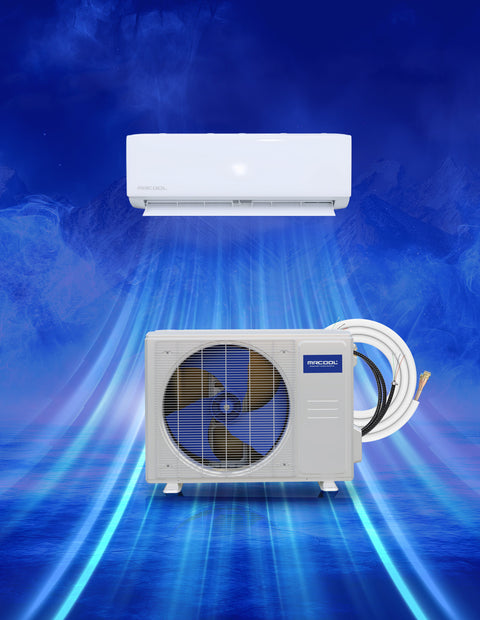
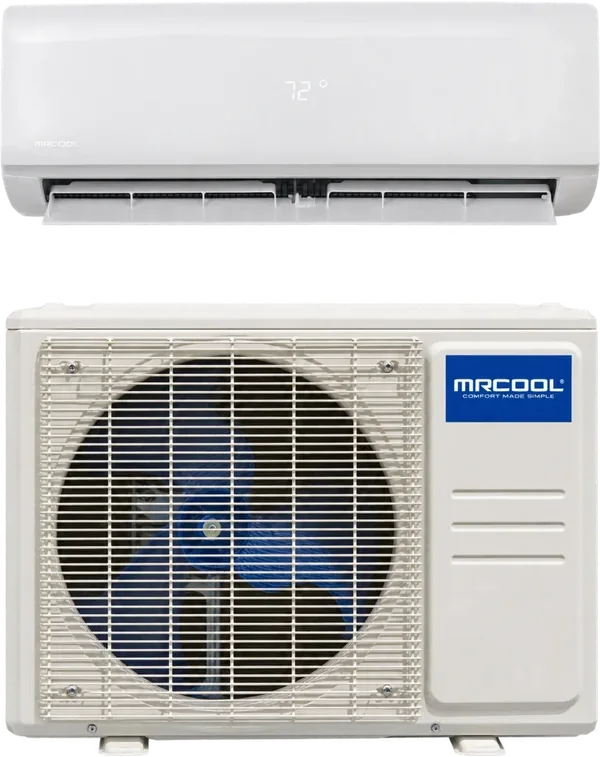
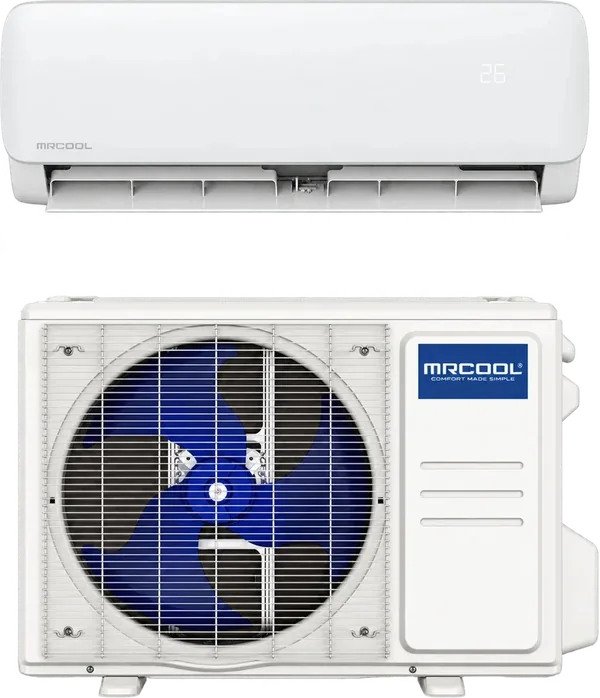
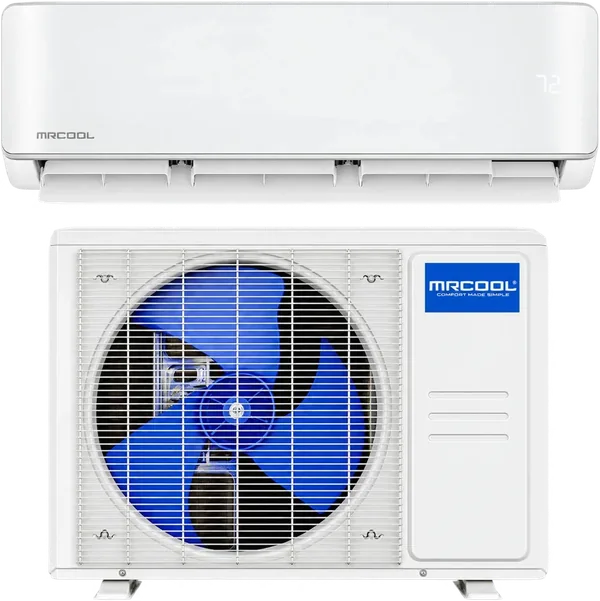
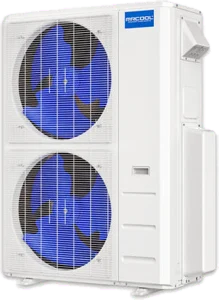
A mini split splits the job in two. The compressor lives in an outdoor unit on a pad or wall bracket. Inside, a slim wall unit moves the air, connected by a line set through a 3 in hole. MRCOOL DIY systems use pre-charged Quick Connect line sets, so you can install one yourself without a vacuum pump or an HVAC tech.
How do they compare side by side?
| Window AC | Portable AC | MRCOOL DIY mini split | |
|---|---|---|---|
| Upfront cost | Lowest | Low | From $1,249 (prices as of November 2026) |
| Compressor location | In the window | In the room | Outside |
| Heats in winter | Most models cool only | Most models cool only | Yes, down to −13°F |
| Efficiency label | CEER on the EnergyGuide label | CEER on the EnergyGuide label | 16.5 to 23.6 SEER2 |
| Blocks a window | Yes | Partly, with the hose kit | No |
| Opening in the house | The window, held by the sash | The window kit | A sealed 3 in hole |
| Every spring and fall | Lift it in, lift it out | Roll it out, drain it, store it | Stays put |
| App and voice control | Some models | Some models | MRCOOL app, Alexa, Google Assistant |
ENERGY STAR points out that a badly installed room air conditioner can leak as much air as a 6-square-inch hole. That's the gap around the unit and the side panels. A mini split's wall hole is sealed around the line set and covered.
Why do noise and heat matter so much?
Noise is a big reason people replace window units, especially in bedrooms. With a mini split, the loud part is outside. Indoors, MRCOOL's silent mode runs as low as 18 dB(A), and the outdoor unit is 54 to 61 dB(A), heard from your yard rather than your pillow.
Heat is the other half. A window unit sits idle or in storage for half the year. A mini split is a heat pump, so the same unit warms the room in winter and can take over from space heaters.
That swap saves real power. A plain electric space heater turns one watt-hour into 3.4 BTU of heat. HSPF2 is measured in BTU per watt-hour across a season, and MRCOOL DIY lines run from 8.3 to 11.5. So the mini split delivers roughly two and a half to three times the heat for each kWh you pay for.
Next: how quiet is a MRCOOL DIY mini split, in real terms?
How do you compare the cost over 10 years?
You don't need a calculator app. Five numbers get you close, and you can plug in your own.
- Upfront. A DIY Select 12K is $1,399. Add a disconnect ($59), whip ($72), pad ($172) and LineGuard cover ($129), and parts come to $1,831, plus an electrician for the dedicated circuit.
- Cooling hours. Guess how many hours a year the unit works at full power. We'll use 1,000 as an example; hot states run more, mild ones less.
- Yearly kWh. Multiply BTU by hours, then divide by the efficiency rating and by 1,000. For a 12K at 17.5 SEER2: 12,000 x 1,000 / 17.5 / 1,000 = about 686 kWh. At 20.2 SEER2, an EasyPro figure, it's about 594 kWh.
- Window unit kWh. Do the same math with the CEER number from its yellow label. CEER and SEER2 are tested differently, so treat this as a rough comparison.
- Your rate. Multiply each kWh figure by the price per kWh on your power bill, then by 10 years. Add a replacement window unit if you expect one to wear out in that time.
If the mini split also replaces space heaters in winter, add that saving using the HSPF2 math above. That's often where the gap opens up most.
Watch how much of the job is drilling and mounting, so you can judge whether it's a weekend you want to spend once instead of lifting a window unit in and out every year.
When does a window unit still make sense?
We sell mini splits, and we'll still tell you a window unit is the right buy in some cases:
- You rent and the lease doesn't allow drilling through an outside wall.
- The hot spell where you live lasts two or three weeks a year.
- You need cooling this weekend for less than a few hundred dollars.
- The room is temporary, like a space you plan to remodel next year.
Portable units fit an even narrower case: a window too small or oddly shaped for a window unit, in a room where you can't mount anything.
What if your room is unusual?
What if my HOA or building doesn't allow window units?
That's a common reason people move to a mini split. The outdoor unit sits on a pad or wall bracket, often at the back or side of the house. Check your HOA rules for outdoor equipment placement first.
What if the room has no outside wall?
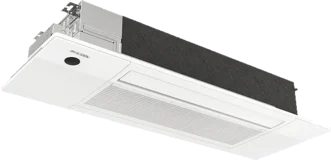
A line set can run through a closet, attic or basement to reach the outdoors, up to 75 ft with a coupler kit. For rooms where a wall unit won't work, the DIY 5th Gen 18K ceiling cassette mounts in the ceiling with a 25 ft line set, for $3,418.
What if I'm cooling three or four rooms with window units now?
One outdoor unit can run 2 to 6 indoor units on the DIY 5th Gen multi-zone. Wall systems start from $2,923 for two rooms and $3,607 for three. Browse the multi-zone systems.
What if I only need a small bedroom cooled?
Start with a 9K. The DIY Select 9K is $1,249, and the 9K and 12K run on 115V, though they still need their own dedicated circuit.
Next: DIY Select, EasyPro or 5th Gen, which one fits you?
What should you do next?
Measure the room you're cooling now with a window unit and check its BTU rating on the label. Then use our sizing guide to pick the mini split size, which isn't always the same number.
Compare prices for that size on our single zone systems page. For help choosing the size and line, call +1 (844) 999-9725, Monday to Friday, 9 AM to 5 PM EST, or text 302-385-6142.