

What does a MRCOOL ceiling cassette installation involve?
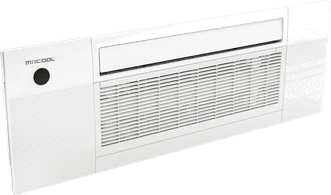
Short answer: A ceiling cassette is a bigger job than a wall unit because it hangs from the framing above the ceiling. Before you buy one, check three things: the joists are on standard 16 in centers, you can get into the attic above the spot, and the ceiling cavity is as deep as the manual asks. If the room has a finished floor above it, a wall unit is usually the better buy. The refrigerant side is the same as any MRCOOL DIY system: a pre-charged line set, no vacuum pump, no gauges.
Will your ceiling take a cassette?
Check these before you order:
- Joists: MRCOOL says the one-way cassette fits between standard 16 in joists, including I-joists. Different spacing? Check the manual and ask MRCOOL before you buy.
- Attic access: the cassette, the line set, the cable and the drain are all worked from above. No attic above the room (a finished floor instead) changes the whole job.
- Depth: compare the ceiling cavity depth with the depth in the installation manual (single zone or multi-zone). Too shallow means a wall unit.
- What’s in the way: wiring, ductwork, plumbing vents or trusses above the spot. Trusses are structural and are never cut.
- The drain: it has to slope downhill the whole way to the outside or an approved drain.
Not sure? Our cassette vs wall unit guide compares the two.
How long does it take?
Plan a weekend for one cassette, with a helper. Lifting the cassette into the ceiling and setting the outdoor unit are two-person jobs. Add the electrician’s visit for the circuit.
What tools do you need?
A drill, a 3-1/2 in hole saw (a core bit for brick or block), a stud finder, a level, a drywall saw, wrenches, a torque wrench if you have one and basic electrical tools.
What’s in the box, and what isn’t?
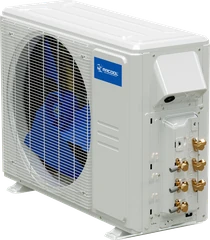
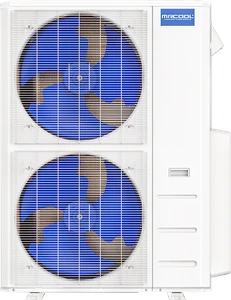
- In the box: the cassette, the outdoor unit and the pre-charged Quick Connect line set. The 18K single zone cassette system comes with a 25 ft line set. Multi-zone systems come with one line set per room: on 2- and 3-room systems you pick each length, and 4- to 6-room systems ship with 16 ft per room.
- Not in the box: a disconnect switch ($59), a whip ($72), an equipment pad ($172) or a wall bracket (from $77), the breaker and wire from your panel, and a line set cover if you want one (from $132).
- Longer routes: line sets come in 16, 25, 35 and 50 ft, and a coupler kit (from $427) reaches 66 or 75 ft. Line sets can’t be cut, so measure the route through the attic before you buy.
What does the electrician do?
The same as for a wall unit: a dedicated circuit, a breaker, a disconnect within sight of the outdoor unit and a whip. Many towns require a licensed electrician for the circuit, and many want a permit.
Who usually does each part?
| Part of the job | Usually done by | What it takes |
|---|---|---|
| Checking the joists, attic and depth | You | Stud finder, tape measure, the manual |
| Cutting the ceiling opening and hanging the cassette | You and a helper | Drywall saw, the hanging hardware, a second person |
| Drain, line set and cable through the attic | You | The manual, two wrenches, a torque wrench |
| Setting the outdoor unit | You and a helper | Pad or bracket, a second person |
| Circuit, breaker, disconnect and whip | A licensed electrician in many towns | A permit if your town requires one |
Questions before you buy
Can I put a cassette in a room with a floor above it?
It’s a much harder job with no attic to work from. A wall unit is usually the better choice there.
Do I need a vacuum pump?
No. The line set is pre-charged and connects by hand.
Can I mix cassettes and wall units?
On multi-zone, yes: pick a wall unit or a cassette for each room on the Build Your Own page.
Keep reading
This article is part of our MRCOOL Mini-Split Mastery Guide, which covers sizing, line sets, electrical, installation and cost in one place.