
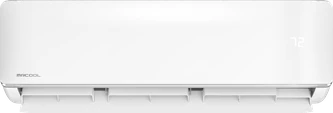
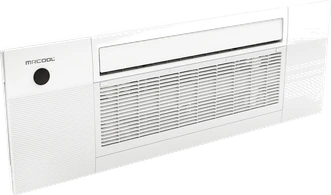
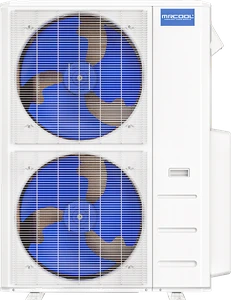

How much electricity does a mini split use?
Short answer: A MRCOOL DIY 12K uses about 510 to 690 watts when it cools at full output, depending on the series. Run that 8 hours a day for a month and it's 123 to 165 kWh, or about $22 to $30 at the U.S. average of 18.16¢ per kWh. Most of the time an inverter runs below full output, so your real bill is usually lower.
Running cost is the second question people ask us after price, and it's easier to answer than most people think. You need three numbers: the unit's BTU size, its efficiency rating and your power price from your bill.
Below we work it out for every MRCOOL DIY size and series, show how much your state's power price changes the result, and compare heating with electric baseboard.
How do you work out a mini split's power use?
- Watts while running = BTU ÷ SEER2 for cooling (BTU ÷ HSPF2 for heating).
- kWh = watts × hours ÷ 1,000.
- Cost = kWh × your price per kWh.
Example: a DIY EasyPro 12K is rated 12,000 BTU at 19.5 SEER2. 12,000 ÷ 19.5 = 615 watts. Eight hours a day for 30 days is 240 hours, so 615 × 240 ÷ 1,000 = 148 kWh. At 18.16¢ that's $26.82 for the month.
SEER2 is a seasonal average, so this is an estimate, not a meter reading. It's close enough to compare sizes and series and to budget for a summer.
How many watts does each MRCOOL DIY size use?
Average watts at full cooling output, from each model's rated cooling BTU and SEER2:
| Size | DIY Select | DIY EasyPro | DIY 5th Gen |
|---|---|---|---|
| 9K (115V) | 514 W (17.5 SEER2) | 446 W (20.2) | 381 W (23.6) |
| 12K (115V) | 686 W (17.5) | 615 W (19.5) | 511 W (23.5) |
| 18K (230V) | 983 W (17.3, rated 17,000 BTU) | 850 W (20.0, rated 17,000 BTU) | 800 W (22.5) |
| 24K (230V) | 1,394 W (16.5, rated 23,000 BTU) | 1,270 W (18.9) | 1,057 W (22.7) |
| 36K (230V) | Not made | Not made | 2,000 W (18.0) |
What does a month of cooling cost?
Here's 240 hours at full output, about 8 hours a day for 30 days, at the U.S. average residential price of 18.16¢ per kWh (EIA, August 2026).

| Size | DIY Select | DIY EasyPro | DIY 5th Gen |
|---|---|---|---|
| 9K | 123 kWh, $22.41 | 107 kWh, $19.42 | 92 kWh, $16.62 |
| 12K | 165 kWh, $29.89 | 148 kWh, $26.82 | 123 kWh, $22.26 |
| 18K | 236 kWh, $42.83 | 204 kWh, $37.05 | 192 kWh, $34.87 |
| 24K | 335 kWh, $60.75 | 305 kWh, $55.34 | 254 kWh, $46.08 |
| 36K | Not made | Not made | 480 kWh, $87.17 |
These assume the unit runs flat out every one of those hours, which is a hot month. On mild days an inverter drops well below full output, so treat these as the high end.
How much does your power price change it?
More than the series does. The same DIY EasyPro 12K month costs less than $20 in Louisiana and more than $45 in Massachusetts.

Your exact price per kWh is on your power bill, usually as the total charge divided by the kWh used. Put it into the formula above with the SEER2 of the model you're looking at.
How much does a mini split use for heating?
Heating uses the HSPF2 rating instead of SEER2. MRCOOL DIY ranges are 8.3 to 9.0 for DIY Select, 8.5 to 9.3 for DIY EasyPro and 8.5 to 11.5 for DIY 5th Gen. At an HSPF2 of 9, making 12,000 BTU of heat takes about 1,333 watts: 320 kWh, or $58, over the same 240 hours at the U.S. average.
Electric baseboard heat making the same 12,000 BTU uses about 3,517 watts. That's 844 kWh, or about $153, for the same 240 hours. This is where a mini split saves the most money.
A heat pump works harder as it gets colder outside, so a week of single-digit nights costs more than the HSPF2 average suggests. The DIY EasyPro and DIY 5th Gen keep heating down to −13°F and the DIY Select down to −12°F.
Is the more efficient series worth the extra money?
At 12K, the DIY 5th Gen saves about $7.63 a month over the DIY Select in our cooling example. Over a four-month summer that's about $31 a year, against $960 more up front. At 24K the gap grows to about $14.67 a month.
So on cooling alone at an average price, efficiency pays back slowly. It pays back faster when the mini split is your main heat through a long winter, when your power costs 25¢ or more, or when you run it most of the day. Most people who choose the DIY 5th Gen do it for the 25 ft line set, the warranty or multi-zone, and the lower bill comes with it. Our series comparison covers the rest.

Next: Does your size need a 110V or a 220V circuit?
How to keep a mini split's power use low
- Buy the right size. A unit that's too big short cycles and leaves the air damp, and one that's too small runs flat out all day. The sizing guide takes 5 minutes.
- Set it and leave it. An inverter is most efficient holding a steady temperature, not catching up after being off all day. Use the schedule in the SmartHVAC app instead.
- Keep the filters clean. Rinse them every month or so in heavy use. See our cleaning guide.
- Give the outdoor unit room. Keep plants and snow at least a foot or two away so it can breathe.
Want help picking the most efficient size for your room? Call +1 (844) 999-9725, Monday to Friday, 9 AM to 5 PM EST.
Sources: SEER2 and rated BTU from MRCOOL's specifications for each model. Power prices: U.S. Energy Information Administration, Electric Power Monthly, Table 5.6.A, average residential price, August 2026 (preliminary). Prices as of November 2026.


